Governed Crossing
A governed crossing record is evidence that data crossed from a person’s own system into shared infrastructure: what was authorized to cross, by whom, when, under what exposure claim, and where it landed. This repository holds the ways that record is written down (bindings), the rules a record must meet beyond its schema (conformance), and, in time, test vectors and a reference verifier.
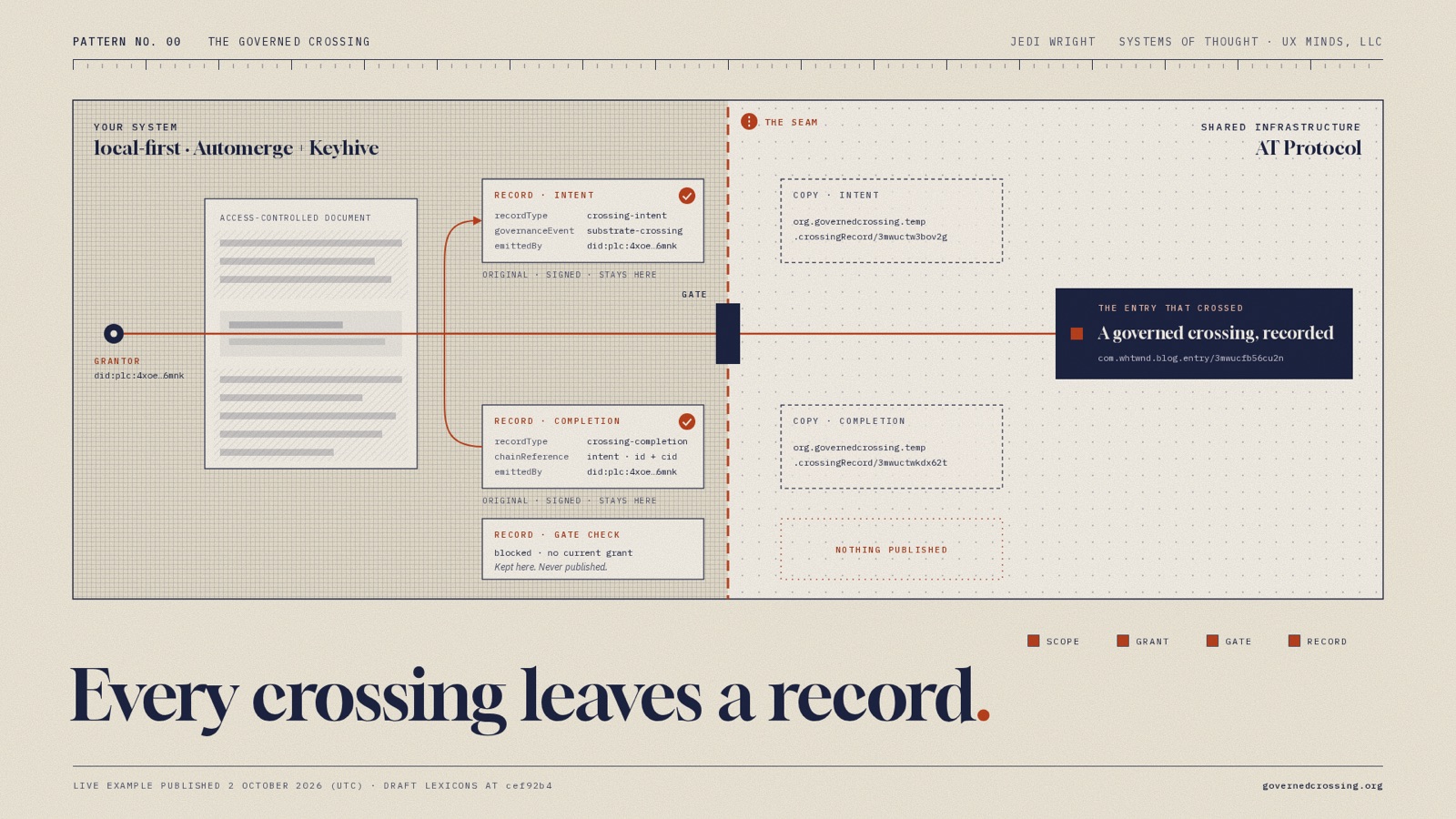
One crossing, start to finish. Click through for the animated version.
The record’s meaning is defined by the seam:CrossingRecord vocabulary in Seam Stack. This repository does not redefine it; each binding maps onto it.
Status
Draft. The first binding is a set of AT Protocol lexicons in the org.governedcrossing.temp.* namespace. Anything under temp may change without notice. Stable org.governedcrossing.* names will be published separately and will not be implied by use of the drafts.
Open for feedback: drafts/access-change.md, a draft for recording access changes. Files in drafts/ are not part of the specification.
Live examples
One public crossing, recorded as an intent and a completion. Published 2 October 2026 (UTC) from a project test account.
| AT-URI | |
|---|---|
| The entry that crossed | at://did:plc:4xoefmmbsulm4xns3kbb6mnk/com.whtwnd.blog.entry/3mwucfb56cu2n |
| Intent | at://did:plc:4xoefmmbsulm4xns3kbb6mnk/org.governedcrossing.temp.crossingRecord/3mwuctw3bov2g |
| Completion | at://did:plc:4xoefmmbsulm4xns3kbb6mnk/org.governedcrossing.temp.crossingRecord/3mwuctwkdx62t |
The crossing code wrote an intent before the entry was published, and a completion after the publish succeeded. Both were then put into this record format and signed, about eight minutes after the crossing; the completion links back to the intent. The timestamps inside the records are the emitter’s own declaration of when each was first written. The published records are copies; the signed originals stay on the emitter’s own system.
Check them yourself
- Open either record in any PDS browser, or fetch it with
com.atproto.repo.getRecord. - In the completion,
chainReference.recordIdis the intent’srecordId, andchainReference.cidis the intent’s link CID (CONFORMANCE.mdsection 7). - Run
npm ciintools/, thennpm run verify -- <AT-URI>. It verifies the emitter signature against the key in the DID document and checks the link.
What has and has not been verified
The signatures follow the ATProtocol Attestation Specification v1.0 and CONFORMANCE.md section 3. They verify with the code in tools/, which is this project’s own code, and with one independent tool: atproto-attestation-verify built from the atproto-crates repository at commit e63a87bb (version 0.15.0-rc.5) reports both records as verified. Version 0.14.5, the latest on crates.io on 2 October 2026, rejects them. The two versions differ on how a bytes field outside signatures enters the signed CID: these records use a CBOR byte string, as in the AT Protocol data model; 0.14.5 uses the JSON {"$bytes": …} map. Every record here carries a bytes salt, so the two give different CIDs. From 0.15.0-rc.5 the tool uses the data-model form, and its README says so. Until 0.15 is published, build the verifier from source to check these records independently. The tool’s README cites a separate specification text, badge.blue. These records differ from it on two points: the signature is base64 without padding, where badge.blue writes padding, and the signature entry has no cid field, where badge.blue adds one. Neither stops the records verifying: badge.blue tells decoders to accept unpadded input, and the verifier recomputes the CID and does not read a stored one. Whether these lexicons should adopt both is open for their next revision.
The host accepted both records without validating them and reported the validation status as unknown, which is what the reference server does for a lexicon it does not have built in. The records were validated against the lexicons in this repository before they were published.
Notes
- Made against the lexicons at commit
cef92b4. Thetemplexicons are drafts. When they change, a new pair will be added and this one marked superseded; it will not be deleted. - The entry’s title carries the emitter’s local date, 1 October. Record timestamps are UTC.
- The crossing ran on prototype code from
jediwright/employment-seamat commitfb05ea1. Thekeyhive:andautomerge:values in the intent name the software that held the source document. - The account is hosted, so the intent declares
identityCustodyClass: provider-custodied.
Principles
- The record lives with the person. The canonical copy of a crossing record stays on the emitting party’s own system. AT Protocol carries copies of it, never its home.
- A public copy discloses no more than the crossing did. When a crossing is itself public, the full record may be published. When it is private, at most a small commitment is published (a fingerprint of the record, who issued it, and when); the full record travels privately to the other party.
- Crossings that did not go through leave no public trace. Nothing is published about a blocked crossing, or about one whose act the emitter has not seen succeed. The record stays with the party.
- Records are signed and non-repudiable. Every record carries its emitter’s signature, following the ATProtocol Attestation Specification v1.0. This is a deliberate difference from permissioned spaces, which are designed to be deniable.
- Records describe what crossed; they never contain it. A record carries digests and references only.
- Exposure claims are upper bounds. Once data crosses into a globally indexed system, nobody can promise it will not be copied. Records say so (
exposure-unbounded) instead of claiming more control than exists.
Layout
lexicons/org/governedcrossing/temp/
  crossingRecord.json   one record type for all crossing records; recordType tells them apart
  commitment.json       the public commitment to a privately held record
  defs.json             signature type, record references, crossing extensions
CONFORMANCE.md          rules a record must meet that a lexicon cannot express
tools/                  scripts that produced, checked and published the live examples
Relation to the vocabulary
The lexicons list every value currently registered for the vocabulary’s controlled fields. The published vocabulary page lists an earlier subset and is being updated.
License
MIT. See LICENSE.
MIT License · Built with AI-collaborative methods · Intellectual direction and authorial responsibility: Jedi Wright · Systems of Thought · UX Minds, LLC